
• Skip to primary navigation
  • Skip to main content
  • Skip to footer
Logo
  • Home
  • Understanding KCNT1
  • Parents & Caregivers
    • Newly Diagnosed
    • Early-Onset KCNT1 Epilepsies
      • Medications for Early-Onset Epilepsies
    • Sleep-Related Hypermotor Epilepsy (SHE)
    • Symptoms & Treatments Overview
    • Treatment Approaches
    • Genetics 101
    • Life Expectancy & Long-Term Planning  
    • Financial & Caregiving Tools
    • Support & Resources
    • Sign Up for Our Parent Contact Form
    • Share Your KCNT1 Story
    • Find a Doctor
    • World Map (Census)
  • Professionals
    • Clinicians
    • Industry
    • Researchers
      • Biospecimens
      • KCNT1 Funding
      • Publications
  • Research & Clinical Trials
    • Parents & Caregivers
    • Clinical Trials
    • Clinical Trial Educational Resources
  • Support Us
    • Get Involved
    • Ways to Give
      • Shop our Store
      • Host a Fundraiser
  • About Us
    • Our Mission
    • Our Team
    • Our Advisors
    • Our Approach
    • Our Partners
    • Our Families
  • News & Events
    • FDA Patient Session
    • KCNT1 Remembering Day: October 21
    • News
    • Newsletter
    • KCNT1 in Orlando
    • Past Conferences
      • KCNT1 Anaheim Family Conf
      • Million Dollar Bike Ride
  • Contact
  • D♡nate

Carvedilol

Carvedilol

Observational Study

Carvedilol as a potential Anti-Seizure Medication

Your doctor may tell you your child may be a candidate to try carvedilol to reduce seizures due to KCNT1-related epileptic encephalopathy.

Why This Study?

As a caregiver of parent of a loved one with KCNT1-related epileptic encephalopathy, you are aware that this is caused by changes, called mutations, in the KCNT1 gene that can result in a gain of function or hyperactivity of the KCNT1 channel. The gene produces a faulty protein, causing seizures, neurodevelopmental delays, motor dysfunction, reflux, vision issues, sleep disturbances, and other health issues. Many traditional anti-seizure medications are not effective for these patients.

Vanderbilt University has discovered in its labs that carvedilol inhibits KCNT1 channels, which are associated with certain genetic mutations that can lead to seizures. The lab’s findings indicate that carvedilol has the potential to decrease the abnormal brain activity and thereby possibly reduce seizures.

Carvedilol is approved by the US Food and Drug Administration (FDA) for treating high blood pressure and heart failure in adults since 2006 and has a long history of use. Although it is often used off-label in children, it is not approved by the FDA for use in children but safe dosing levels have been published. The effect of carvedilol on seizures is unknown, but research on mice and cells suggests it may alter the activity of the KCNT1 protein and could lead to reduced seizures. This observational study will note if carvedilol helps reduce seizures in those with KCNT1-related epileptic encephalopathy.

Purpose of this Study


Help Track How Well Carvedilol Works for Reducing Seizures

The purpose of this study is to see if carvedilol can decrease seizures in children with KCNT1-related epileptic encephalopathy. The medication is a drug called carvedilol (trade name Coreg).

In this observational study, your child’s doctor will prescribe carvedilol for your child, and you and your doctor will collect information about its effects and your child’s response to it. This will help your doctor determine if carvedilol effectively changes the signs or symptoms of KCNT1-related epileptic encephalopathy, specifically seizure activity.

The decision for the prescription of carvedilol for on- or off-label use lies solely with your doctor, following a discussion involving its risks and benefits with the patient and his or her family.

As with the addition of any new medication, it’s important to be aware of possible side effects. Possible side effects of carvedilol can include rare occurrences of rash, blood-related issues, metabolic changes, issues with slowed heart rate and blood pressure. You will work with your doctor to closely monitor your child’s health and obtain necessary tests and equipment to ensure your child’s safety. If you experience any concerning symptoms or have questions, please contact your doctor promptly.

An Observational Study to Track if it Works

Several doctors have been informed of this potential benefit of carvedilol for seizures. They have the option to administer this medication as part of your treatment regime and can prescribe carvedilol, just as they have prescribed other “new” medications in the past. The KCNT1 Epilespy Foundation would like to follow and observe persons with KCNT1 -related epilepsy who are taking carvedilol in order to track how it works to curb seizures. With an IRB approved study protocol in place we have forms and surveys to learn from your experience and keep track of the response from several KCNT1 patients. Your participation in the observational study will allow your doctor and the KCNT1 Epilepsy Foundation to track the results in a scientifically-rigorous way and share it with other families and clinicians.

If you decide that you’d like your child to participate in this study, you will contact your doctor who will explain the study. If your doctor determines that your child is a good candidate for carvedilol, they will discuss this drug with you.

If you and your doctor decide to try carvedilol, like all medications, you doctor will work with you to assess the effect of this medicine on your child’s health and well-being. As part of your regular treatment process, your child may have an EEG or blood tests. You doctor may require additional in person, virtual or telemedicine visits along with the standard check-ups you normally receive during your clinic visits.


Based on previous dosing schedules in children, your doctor may recommend that the dose escalation of carvedilol is slow. The estimated length of time to get to a therapeutically tolerated level is about 30 weeks. Every two weeks the dose will be increased, depending on your child’s response. This study will involve collecting data from the beginning and throughout the study to monitor how effective it is, and if you experience any side effects. This will include monitoring your child’s heart rate.

You will also have some tasks to do at home. You will keep a daily record of your child’s seizures and measure their heart rate at specific times. Your doctor may recommend other equipment to monitor your child’s heart rhythm, or ask you to purchase a pulse oximeter to monitor heart rate. You will be provided printed forms to help you track your child’s heart rate, seizures, dose, and any other observations.

Later, you will be required to complete additional surveys and upload them to an online drive or mail to a study coordinator. If you need assistance, personnel can assist you.

Unlike many clinical trials, here is no placebo group in this observational study. If you enroll in this study, your child will receive the medication, carvedilol.

If your child takes part in this observational study, it is entirely voluntary. We urge you to discuss any questions about this study with your doctors. Talk to your family and friends about it and take your time to make your decision. If you wish for your child to participate, please discuss it with your doctor.

Potential Risks and Benefits

Potential Risks: While there is always a risk when trying a new medication, this observational study include does not involve any extra medical risks for participants because all medical decisions will be made by a qualified physician based on standard care practices.

The potential risks are related to privacy and confidentiality, but measures are in place to protect participants’ information. These measures are explained in detail in the Informed Consent form.

Also in considering what risks could be associated with participating in the study, answering medical questions in the study may cause some anxiety or distress, but participants can discuss any concerns with the study team, and they are not obligated to answer any questions that make them uncomfortable.

Potential Benefits: There may be no specific benefits to the participant, however they may have personal satisfaction from contributing to KCNT1 research.

Will I Receive a Stipend?

No, you will not receive a stipend at the completion of the study.

How do I know if I qualify for this Study?

Unlike an interventional clinical trial, it is at the medical opinion of your physician to evaluate whether or not your child should be prescribed carvedilol. However, there are characteristics that your doctor may consider in this decision.

Likely Inclusion Criteria

You must sign the informed consent form before we start to talk about whether you are eligible for the study.

Your child must have a diagnosis of KCNT1 related epilepsy and have seizures that are not well controlled with existing medications

You must comply with the scheduled visits, the drug administration plan, laboratory test, and other study procedures and restrictions.

Possible Exclusion Criteria (Your child will likely be excluded if any of these are true):

Has MAPCAs or other cardiac irregularities

Has problems with the liver or elevated liver enzymes such as AST/ALT

Currently has seizures well under control on current medications

How to Get Started

  1. Read about the study on this site. Read the two Informed Consent here and Here. If you believe you’d like to participate, email the Foundation for a e-document to acknowledge you have read it.. (Note, this does not mean that your doctor will prescribe carvedilol.)
  2. Print 2-page Screening form from the Downloads section of this page. Start tracking heart rate and seizures.
  3. Schedule an appointment. If your doctor approves carvedilol, you will contact the KCNT1 Epilepsy Foundation at Manager@KCNT1epilepsy.org They will provide a Study Link Folder for you. It is a private online storage drive that you will upload your scanned/photographed forms for the duration of the study.

What do I bring to my Doctor visits?

You will need to bring your Screening Diary and be prepared to discuss your observation of any changes in seizures, vitals, physical function or communication. Each Visit requires you to bring printed forms for your doctor to complete.


Downloadable Forms for Parents and Doctors

In this observational study, your child’s doctor will prescribe carvedilol for your child, and you and your doctor will collect information about its effects and your child’s response to it. This will help your doctor determine if carvedilol effectively changes the signs or symptoms of KCNT1-related epileptic encephalopathy, specifically seizure activity.

The decision for the prescription of carvedilol for on- or off-label use lies solely with your doctor, following a discussion involving its risks and benefits with the patient and his or her family.

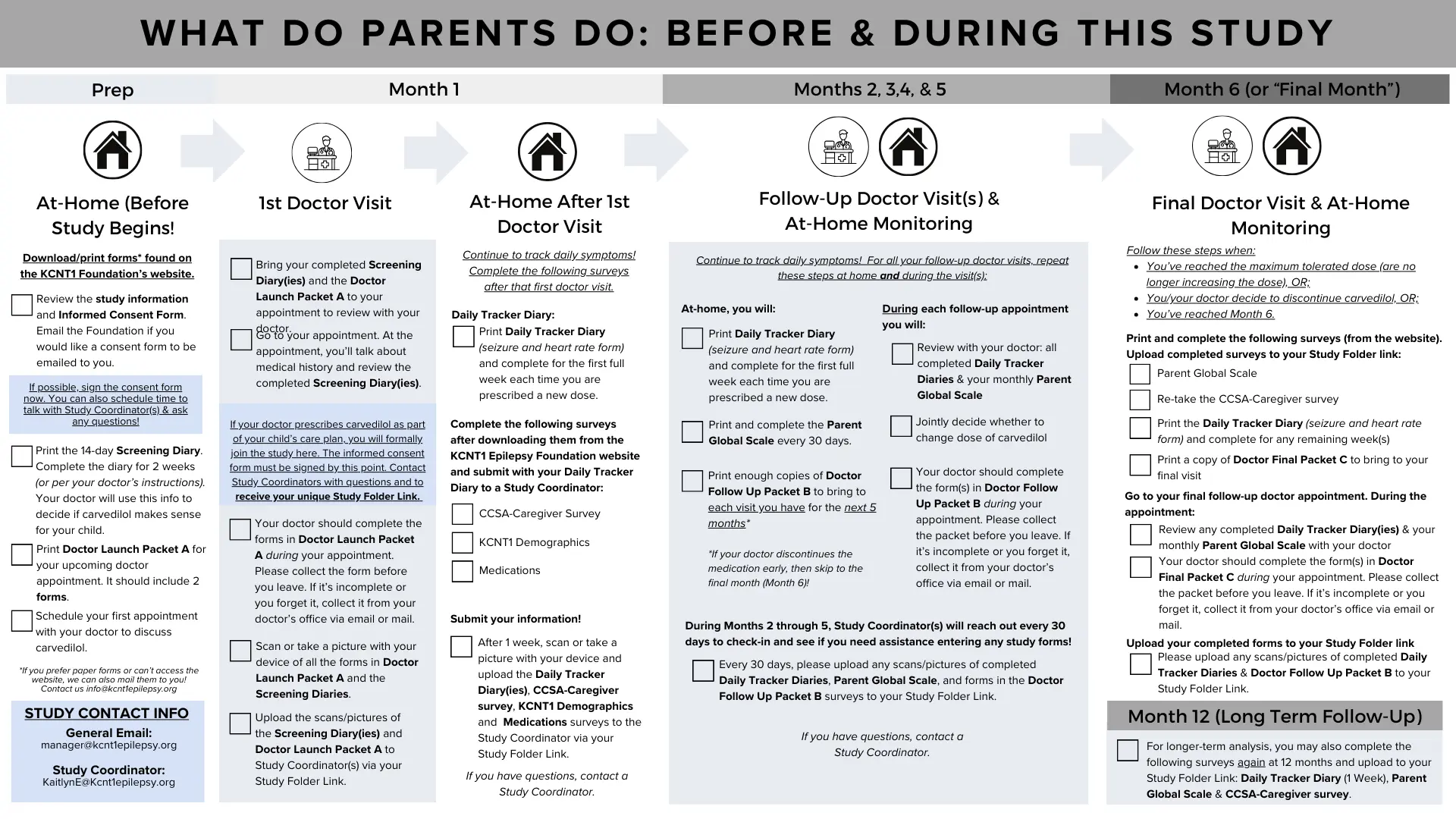
Caregivers can learn more about the steps required in this study in this downloadable handout.

Clinicians can learn more about the steps in this study in this handout.

The study forms can be downloaded below, or they can be mailed to you. If your doctor prescribes carvedilol and you wish to participate in the study, email the KCNT1 Epilepsy Foundation and they will provide a link to an online storage drive for you to upload your completed forms throughout the study.

Informed Consent

Contact the KCNT1 Epilepsy Foundation to request an Informed Consent Form be sent to you. A study coordinator is available to answer questions. You can review the document here.

Screening Diary

Parents are to complete this for up to 2 weeks prior to doctor appointment. Take this with you to first appointment.

Download Screening Form

Daily Tracker Diary

Fill this out for a week each time your doctor changes the dose. Upload it to your a

signed online drive or mail to a study coordinator.

Download Daily Tracker

CCSA-Caregiver Survey

This captures information about how your child is doing before they start the new medication. You will fill it out at the end of the study as well.

Download CCSA-Caregiver

Parent Global Scale

This survey will give a snapshot of how your child is doing in many different areas before, and after taking a new medication.

Download Parent Global Scale

Medication Survey

This is a comprehensive survey about seizure and other medications.

Download Medication survey.

KCNT1 Demographics Survey

Download the Demographics and genetics survey here.

Genetis survey here.


Printable Packet A

This is the packet to take to the first appointment.

–Clinic Intake Form

–CCSA Clinician version

Printable Packet B

This packet is the clinical intake form and an additional assessment to be administered with each follow up visit, in person or virtual.

Clinic Intake Form

Printable Packet C

This packet contains three forms:

  • Clinic Intake Form
  • Clinic Global Impression
  • CCSA-Clinician

Footer

fluid-image
Donate Today
  • Parents & Caregivers
  • Researchers & Professionals
  • About Us
  • Contact
  • Subscribe
Gold 2025 Candid Seal
GAA Member Badge
Citizen Health Proud Partner 2025 Website Badge

Privacy Policy

© 2023 KCNT1 Epilepsy Foundation | All Rights Reserved | Disclaimer

EIN 84-2748218

Copyright © 2026